A new lease on life for Brodie’s Link
BY MIKE BURNS
Many residents of the Hangklip villages will be familiar with the name ‘Brodie’s Link’. Some understand it to be the hiking trail that leads up to the summit of Hangklip mountain. The name has also been ascribed to a footpath linking Pringle Bay with Silversands in Betty’s Bay. However, it is none of these.
What is Brodie’s Link?
Brodie’s Link is a block of land consisting of five adjoining farm portions (with a combined area of 1068 hectares) that were purchased to create an extraordinarily valuable ecological corridor. It encompasses the Hangklip mountain massif in the west, the catchment through which the Hangklip Valley stream flows, and the Blesberg mountain and surrounds in the east, where it adjoins an area of municipal nature reserve adjacent to Silversands.
Its origin dates to 1998 when the Brodie family purchased the first of the block’s five farms, ‘Koppie Alleen’. The alternative to this conservation-oriented gesture would almost certainly have been urban development. The other properties were acquired over an extended period, ending in 2010. Funding for much of this was provided by Simon Marais – someone who loved the Western Cape’s fynbos-clad mountains. Brodie’s Link is now held in trust by WWF, with CapeNature appointed as the management agency.
A creeping infestation
Almost unnoticed since its establishment as a conservation area, Brodie’s Link became heavily infested by invasive alien vegetation. The area’s natural biodiversity was crowded out by dense thickets of Australian acacias (mostly Acacia cyclops, rooikrans). Among other impacts, its capacity to sustain the functioning of the Hangklip Valley stream and associated wetlands was reduced because of the greater water uptake by the invasive thicket compared to fynbos.
A restoration opportunity
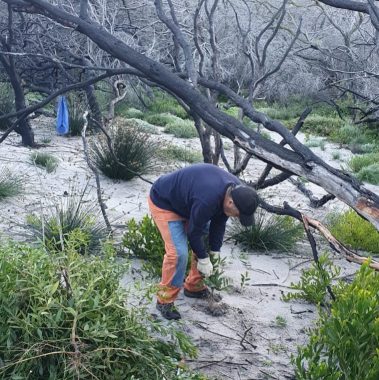
The wildfire of January 2024 created an opportunity to tackle the ecological restoration of Brodie’s Link. Most of the acacia thicket was killed by the fire, which was also hot enough to incinerate a proportion of the standing woody biomass. Anticipating the widespread germination of soil-stored acacia seed, the local hacking community put in a huge effort to hand-pull literally hundreds of thousands of rooikrans seedlings, creating space for long-absent fynbos species to regain a foothold in the cleared areas. However, it was soon realised that the regrowth rate of invasive species exceeded the capacity of the hackers to stay ahead of the process of re-invasion.
The Sugarbird Project Arrives
And then, something remarkable happened. The Sugarbird Project (https://sugarbird.org.za), a nonprofit organisation focused on the eradication of invasive alien vegetation from Western Cape fynbos ecosystems, offered to assist.
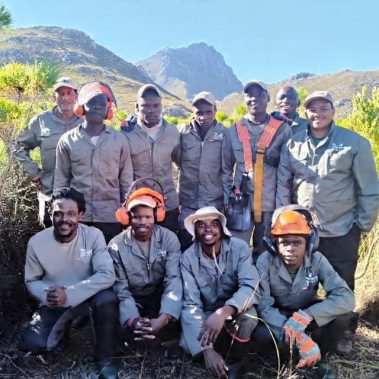
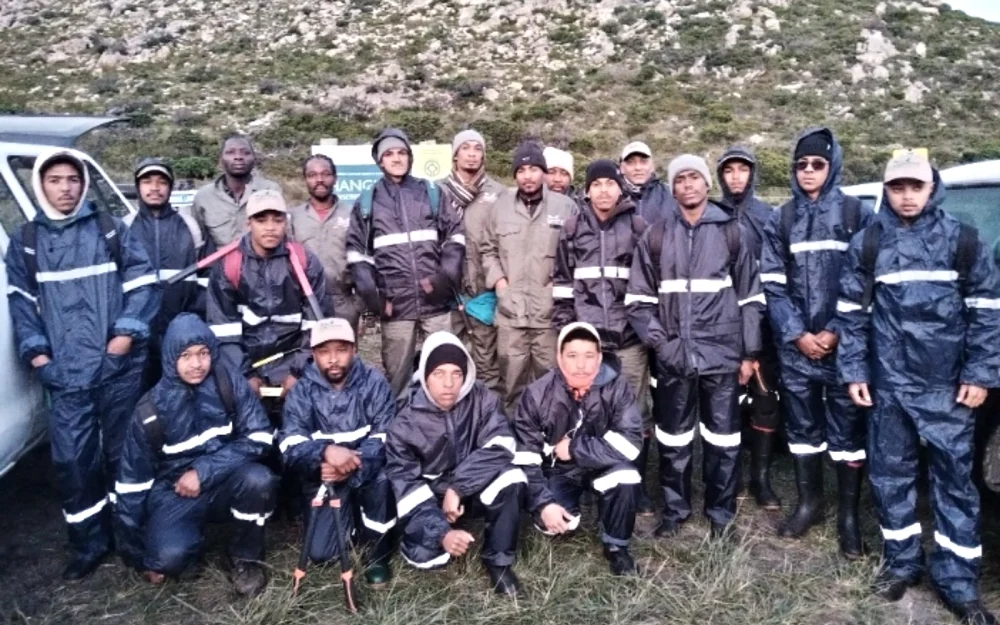
A fully funded team of Sugarbird staff was deployed in July 2026 to systematically clear Brodie’s Link of invasive alien vegetation. This followed on from the team’s sterling work clearing the Buffels Dam catchment of Hakea, the Rooiels-Pringle Bay valley wetlands of Bottlebrush, and the coastal plain beneath Old Porter Drive, near Rooiels, of Spidergum, Pines and other problem species.
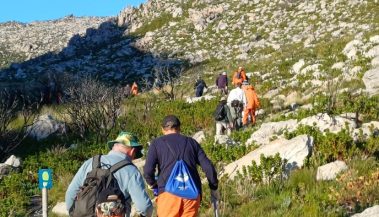
Applying best-practice techniques, the trained team is well equipped and subject to expert supervision, including from within the Hangklip community. Not only does their work entail initial clearing operations, but annual follow-up operations are scheduled, for as long as it takes to restore the environment to a level of routine management.
To extract some value from the cleared biomass, small-scale harvesting of firewood from some of the dead rooikrans trees is also carried out. This aims to improve access to the area to assist future clearing operations and to reduce fire risk through the removal of dry, superfluous fuel.
Hikers visiting the Hangklip Valley may encounter the team working high on the slopes of Hangklip. In months to come, they will move to other areas of Brodie’s Link. The staff will almost certainly welcome a friendly greeting and word of encouragement.
A word of gratitude
Coming to the rescue in a time of dire need, was the Marais family once again. Without their financial support for the current initiative, through the Sugarbird Project, the ecological restoration of Brodie’s Link would not be possible. As a community, we are extremely grateful for this support.