Rooiels leopard cameras: a short history
BY RALPH PINA
In the years before the cameras were set up, a lucky few residents had spotted leopards in or near Rooiels. A book, Die Luiperdman van die Kogelberg (2000) by Gerald McCann, even recounts an undated and unverified story of a child being attacked by a leopard during the early days of the village, near the river cave. At the behest of panic-stricken villagers, a “jakkalsman” (vermin control officer) and his pack of dogs killed one of her nearly full-grown offspring (to everybody’s apparent relief), although it was probably the mother who was responsible, protecting her cubs.
Leopards in our midst
Fast forward to 2010, to more enlightened times. The Cape Leopard Trust (CLT) was founded in 2004 to protect the Cape leopard (Panthera pardus pardus) and its habitat. They conducted a camera survey near Rooiels as part of its Boland research project. The project revealed 18 leopards and 2 cubs in the vast, mountainous area spanning Jonkershoek, Hottentots-Holland and the Kogelberg Biosphere Reserve.
Inspired by these events, two Rooiels residents, Jill Lockley and Wolfgang Steinbach, witnessed a leopard crossing the R44 and with great excitement, explored the riverbank, where they discovered tracks in the river cave.
The first cameras
Soon the Rooiels Conservancy, under the leadership of Anuta Scholtz, had acquired its own cameras and these were mounted in the cave and at other locations around Rooiels by Wolfgang and Jill. Telling the story, Jill exclaimed that it was “so exciting!”. Now living in Bristol UK, she tells how she misses Rooiels. Africa is in her blood. Wolfgang is still here.
an ongoing legacy
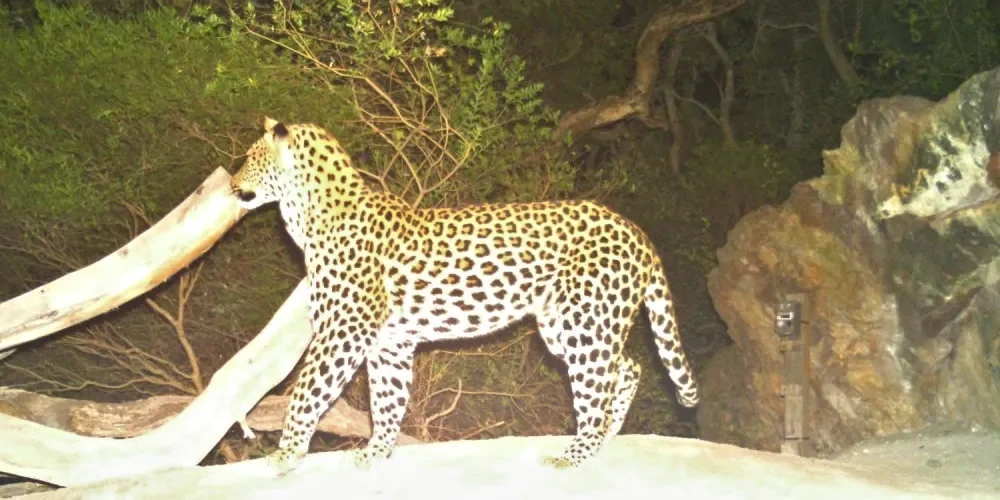
And so, the long tradition of monitoring and servicing the camera traps began, with images being shared with the Cape Leopard Trust, and the Rooiels community, to this day. At the end of 2025 the CLT conducted another survey near Rooiels. The survey which encompassed the area south of Bainskloof to the southern Kogelberg coast revealed 38 different cats: 22 males, 11 females, at least 2 of which had cubs, and 5 of unknown sex.
Leopards have names too
Scott (BM12), long the dominant male in the Kogelberg, was often observed and was fitted with a tracking collar in 2013 by the CLT. He was last spotted on our cameras on 20 March 2017, according to the late Dick Lockley’s notes, and is deceased. In the meantime, two other cats made their appearances: Rosy and Diego (or Diago, BM27) in 2016. Diego was a regular, appearing almost monthly until he came to a tragic end in late 2024 – caught in a snare near Sir Lowry’s Pass. In 2019 a leopard designated as Newby arrived on the scene at two of our camera locations.
During the last year since Diego’s demise, after six months of zero observations, two more leopards, of which one appears to be BF28, have started to frequent the area. We are still awaiting identification of the other one from the Cape Leopard Trust.
References:
- https://af.wikipedia.org/wiki/Kaapse_luiperd
- Breeze, North-Western Edition 2011
- Breeze 2013
- Jill Lockley – personal conversation Feb 2026
- Wolfgang Steinbach – correspondence Feb 2026
- Cape Leopard Trust 2025. Back to the Boland! Spotting leopards and highlighting biodiversity