The Pringle Bay Troop in Rooiels: A Predictable Consequence?
THE ROOIELS CONSERVANCY
The arrival of the Pringle Bay baboon troop in Rooiels was an unexpected event. Or was it?
Overstrand Municipality’s Adaptive Baboon Management Programme (ABMP) does not simply aim to reduce the troop’s presence in Pringle Bay. Its stated aim is to push the Pringle Bay troop out of the village, preferably northwards towards the Rooiels Conservancy. [1]
That raises an obvious question:
If the management strategy was to move the troop towards Rooiels, should its eventual arrival in Rooiels really have been surprising?
Baboon home ranges are shaped by ecology, not artificial boundaries
Baboon troops do not use landscapes according to municipal boundaries. On the coastal plains of the Kogelberg region, they have occupied the same ecological niches for thousands of years. Their home ranges are not arbitrary. They are shaped by three non-negotiable needs:
- Daily access to fresh water
-
- Steenbras troop → Steenbras River
- Rooiels troop → Rooiels River
- Pringle Bay troop → Buffelsrivier
- Reliable daytime foraging grounds: the flat coastal plains contain the bulk of natural food sources. This is where baboons have always foraged.
- Safe sleeping sites: troops retreat to steep cliffs and high ground at night to avoid predators.
The villages of Rooiels and Pringle Bay were built on these core foraging zones. Humans chose the flat, buildable land – the same land baboons rely on for survival.
Any management plan which seeks to keep baboons “out of town” seeks to exclude them from their core home ranges.
What happens when a troop is continually excluded?
The ABMP uses monitors armed with paintball guns, gel blasters, bird bangers and other aversive tools to inflict pain and fear. The objective is behavioural change – the baboons will learn that being out of town is more favourable than being in town.
But research shows that aversive management does not produce a simple “avoid town” response. Instead, baboons vary in how they respond to management, and their use of urban space is influenced by both management pressure and their own ecological and social behaviour. [2]
In other words, baboons adapt to management interventions imposed on them.
The question is where do those changes lead?
A changing pattern of movement
The ABMP’s preferred solution is to move the troop northwards into the Rooiels Conservancy. The village of Rooiels is only about five kilometres away.
Movement data from the Pringle Bay troop shows a trend of broader ranging behaviour and increased variability in daily travel distances. [3]
Given that the ABMP’s strategy is to push the Pringle Bay troop towards the Rooiels Conservancy, and that they are travelling greater distances since its introduction, the question is:
Was the troop’s arrival in Rooiels a foreseeable, even inevitable, consequence of that approach?
The predictable consequence
The Pringle Bay troop arrived in Rooiels and found:
- abundant food
- fresh water
- no monitors
- no daytime harassment
The Rooiels troop happened to be further north at the time, unaware of the Pringle Bay troop’s presence. However on subsequent days, there was inter-troop conflict within the village.
Different troop, different behaviour
Rooiels residents noticed a striking difference between the two troops. While the Rooiels troop successfully enters houses occasionally, it is not as persistent as the Pringle Bay troop.
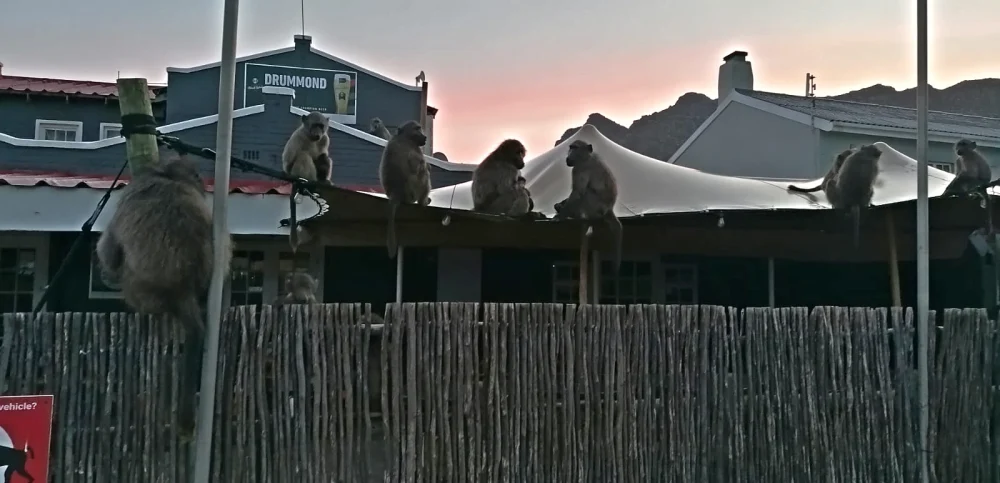
The Pringle Bay troop slept on roofs each night they were in the village – something the Rooiels troop never does.
Research has shown that baboons living under intensive management pressure adapt their behaviour. In Pringle Bay, that management pressure consists of continuously “pushing” the troop using paintball guns, gel blasters and other aversive “management tools”. It has sometimes also included flashing strobe lights and discharging weapons at natural sleep sites at night time.
Outcomes for the Pringle Bay troop:
- They’re unable to peacefully forage uninterrupted, or in their preferred areas
- They come into the village after dark to feed
- They routinely sleep on roofs
In contrast, the Rooiels troop:
- Forages peacefully according to its natural movement patterns
- Enters the village on most days for 2-3 hours, mostly without incident
- Makes its way to a natural sleep site every night before dark
The contrast between the two troops raises some important questions:
Does the different histories of these troops contribute to the different behaviours they display?
Does the ABMP create and perpetuate the very behaviour it later tries to manage?
The management contradiction
When concerns were raised about the Pringle Bay troop’s presence in Rooiels, one of the Municipality’s responses was:
“Why should people interfere with the troop’s natural movement?”
Yet interfering with the troop’s movement is precisely what the ABMP is designed to do.
Every day, monitors prevent the Pringle Bay troop from entering areas where it would otherwise forage. Every day, the troop’s movements are influenced by management intervention. The question is not whether the Municipality is affecting the Pringle Bay troop’s movement. It is.
We have to ask:
If a strategy deliberately moves a troop towards a neighbouring community, what responsibility does that strategy have for the consequences that follow?
The questions that remain
The Pringle Bay troop’s arrival in Rooiels was not simply a matter of baboons choosing to move into a neighbouring village. It occurred after years of intensive management pressure, under a strategy that deliberately sought to push the troop northwards towards the Rooiels Conservancy.
A management approach that focuses only on keeping baboons out of one village risks overlooking what happens when those baboons are pushed into the surrounding landscape. Baboons do not disappear. They still need food, water and safe sleeping sites. They still have to move through the habitat they have occupied for generations.
The Pringle Bay troop’s arrival in Rooiels should therefore not only be viewed as a baboon problem. It should be viewed as both a management question and an ethical question.
Have the consequences of the ABMP have been properly understood by the Municipality?
Does it intend to adapt its behaviour based on those consequences?
If a strategy perpetuates the problems it seeks to manage, and creates new ones, is it serving any material purpose?