
Leopards
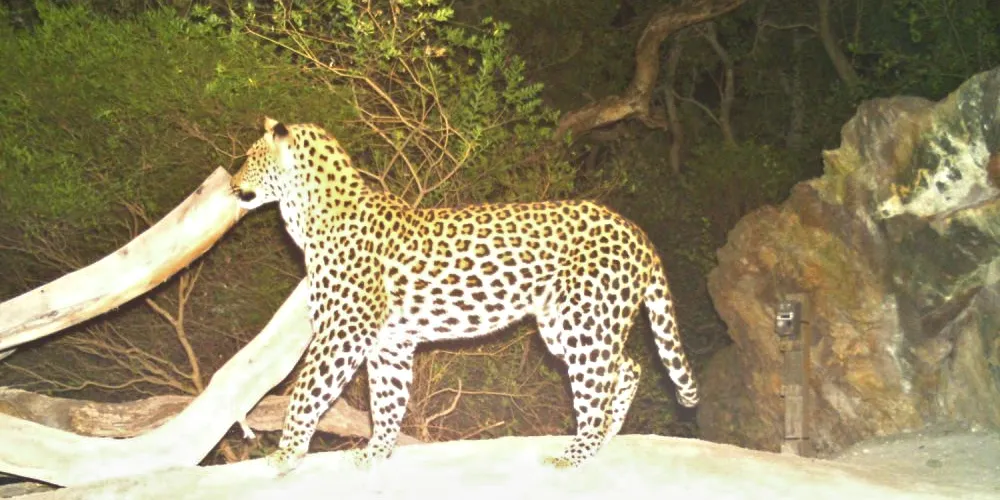
The Cape Leopard (Panthera pardus pardus) is one of the most elusive and extraordinary residents of our landscape. They are rarely seen by people, but thanks to our wildlife cameras, we know they move quietly through the Rooiels river ravine and surrounding hills at night and dawn. In 1987, a small dog was taken by a leopard in the village. Sadly, a local later tracked and killed it.
The Cape Leopard has distinct genetic characteristics compared to those in the interior of the country. They are smaller in size, require very large home ranges (sometimes hundreds of square kilometres) – and sustain themselves on smaller native prey rather than large ungulates. Although our local leopards have distinct adaptations, they are not considered a separate sub-species.
Leopards are listed as Vulnerable on the IUCN Red List due to habitat fragmentation, small population sizes and human persecution. Their long‑term persistence depends on connected natural areas, sufficient prey and low conflict with humans.
🙋 How you can help
- Keep your pets indoors at night
- Report any sightings with date and location to the Conservancy.
- Report snares to the Snare Free hotline on 076 127 8485.
Latest updates



Did You Know?
◻️ A leopard’s rosette pattern is as unique as a fingerprint and is used by researchers to identify individuals.
◻️ The call of a leopard is often described as resembling a “sawing wood” sound – eerie and distinctive in the night.
◻️ Research estimates there are between 175-588 leopards left in the Western Cape.
◻️ The Conservancy uploads camera sightings to the Cape Leopard Trust’s portal to aid identification and tracking.
About Cape Leopards
The leopards of the Western and Eastern Cape show some differences from populations in places like the Kruger or Limpopo. They are smaller in body size, shyer, have a longer coat and more distinct markings. Their home ranges are larger because prey is more dispersed in fynbos ecosystems.
Populations tend to be more isolated and fragmented, which creates limited mating and genetic mixing opportunities. If mating is successful, females can give birth every 12-18 months, after a three month gestation. There are usually two cubs per litter, although sometimes one or three. Cubs stay with their mothers for 18-24 months, before dispersing to establish their own territories.
Leopards are expert stalkers, relying on stealth more than speed. Their rosetted coats blend perfectly into the mixed fynbos and rocky slopes around Rooiels, making them nearly invisible during the day. They are opportunistic hunters whose local diet includes smaller mammals such as dassies, klipspringer, grysbok, porcupines and occasionally baboons. This diet reflects the smaller, more dispersed prey of the fynbos ecosystem, compared with the larger animals they predate on in other areas of the country.
Life In The Wild
For a leopard, life around Rooiels is a continuous dance between opportunity and caution. They are mainly nocturnal, and emerge at dusk to make their way along the mountains, slopes and riverside patrolling their territory and searching for prey. During the day they rest in dense fynbos or rocky cover. They rarely spend long in any one spot, crossing vast ranges in search of food, mates, and safe resting spots, far from human eyes.
We see signs of their presence – spoor on trails, and the occasional camera image. But we have little insight into their hidden lives, and too often get bad news about their fates. In 2024 we received news that Diego, a leopard who had been photographed on our cameras on a few different occasions had died after being caught in a snare. Leopards face many dangers and threats as they move through the landscape. We are incredibly fortunate to still share our home with this magnificent and mysterious cat.