
Baboon FAQs
The Conservancy has put together a comprehensive set of FAQs to help residents and visitors with any questions they might have. It covers topics from how the Rooiels troop spends its day, to handling different types of baboon encounters, to baboon vocalisations and facial expressions.
Please take a look, and share with anyone who has questions.
If you’d like to suggest a new FAQ, contact us at rec@rooiels.org.za.
▸ 1. Baboons 101 (17)
There are a few basic guidelines to abide by when you’re out and about in Rooiels. Sticking to these will minimise unwanted interactions, and give you the rare chance to observe wild and free baboons getting on with their own lives.
- Firstly, baboons are only interested in your food, not you. Almost all incidents between baboons and people revolve around food.
- Never feed baboons intentionally. You may have kind intentions, but giving them food or drink seriously harms them in big and small ways. Giving a baboon food means it sees you as submissive, and primes it to continue to seek out food from people. This creates dangerous scenarios and causes baboons to be labelled as “problems”. The consequences can be deadly.
- Don’t walk around the village eating or carrying food items. If you have food on you, put it in a backpack or sturdy bag. Keep picnics in a lockable box, and only serve up food as you need it rather than laying out a spread.
- If you do end up in a situation where a baboon wants your food, just drop it on the floor and move away calmly. They are focused on your food, so separate yourself from it. If you try to hold onto your food they will try to snatch it from you.
- Be quiet and calm if the baboons are nearby or walking past. They are generally indifferent to people if they don’t have food, and will ignore you.
- Keep your distance, and don’t approach, touch or try to challenge them in any way.
- Always keep dogs leashed and under control. If your dogs are reactive to baboons, avoid passing them too closely and take a detour.
- Always lock your car doors, whether you’re inside or not. Baboons can open car doors, and often find food rewards inside, so don’t allow them to access your vehicle. If the baboons are around, close the windows too.
- Drive slowly and carefully! Many of our wild creatures are horribly injured and killed on the roads in and around Rooiels. Respect the speed limits, and watch out for baboons and other wildlife as you drive. If you spot animals on the road, slow down as you pass, and don’t overtake.
- Put all your rubbish in a baboon-proof bin. If you can’t find one, or it’s overfilled, take it with you and dispose of it at home.
The oldest baboon fossil is a skull found in South Africa at the Cradle of Humankind World Heritage site. It’s thought to be more than two million years old. It was identified as belonging to the baboon species Papio angusticeps, which is closely related to modern baboons.¹
They have probably been on the Cape Peninsula for at least a million years and feature richly in Khoisan folktales² and South African rock art³. The first written records we have were by Europeans, starting from 1591 when an Englishman wrote “Here also are a great store of overgrown monkies…”⁴.
Baboons have lived in this area for millennia before the Rooiels township was founded in 1948.
1 University of the Witwatersrand. “Earliest baboon found at Malapa.” ScienceDaily, 19 August 2015. www.sciencedaily.com/releases/2015/08/150819143639.htm
2 Rafapa. Athens Journal of Philology. https://www.athensjournals.gr/philology/2016-3-2-2-Rafapa.pdf
3 Mazel. Newcastle University and University of the Witwatersrand. 2023. https://www.bradshawfoundation.com/rockartnetwork/sheep_baboon_paintings_junction_shelter.php
4 Kansky. Baboons on the Cape Peninsula. 2002. https://baboonmatters.org.za/wp-content/uploads/2020/06/Ruth-Kansky-Baboons_on_the_Cape_Peninsula-booklet.pdf
The Chacma baboon, which is one of six baboon species.
Chacma is derived from the Khoikhoi word for baboons ‘cho-achamma’ or ‘choa kamma’ Their scientific name Papio ursinus means ‘bear-like baboon’.
There are two sub-species of Chacma baboon. Here in Rooiels, and across southern South Africa, you’ll find the Cape chacma (Papio ursinus ursinus). The other sub-species is the Grey-footed chacma (P. ursinus griseipes) which ranges from northern South Africa up into Zambia, Namibia and Angola.
Baboons play a crucial role in the health of our fynbos, by dispersing seeds in their droppings, pollinating flowers, and aerating the soil as they dig for bulbs and tubers. The small depressions they leave after digging up a treat are also handy microhabitats for wind-carried seeds, providing them a protected spot in which to germinate.
Baboons are intelligent, adaptable, social and communicative. They can assess a situation and make informed decisions very quickly. They are skilled at sizing up a threat or opportunity, analysing their surroundings and escape routes, and taking quick action.
As for book-smarts, one study has shown baboons to have innate quantitative abilities equivalent to a three year old human¹.
Never mind Jack, a Chacma baboon who held down a day job as an assistant railway signalman for 9 years!².
1 University of Rochester. “Monkey math: Baboons show brain’s ability to understand numbers.” ScienceDaily. 3 May 2013. https://www.sciencedaily.com/releases/2013/05/130503132719.htm
2. https://en.wikipedia.org/wiki/Jack_(baboon)
A large male baboon, with its impressive canines certainly looks fearsome, and will commonly elicit remarks like ‘They are vicious’, ‘They can tear you to shreds’ and ‘Imagine the damage those teeth can do’. But the fact is that baboons are not predators, and are generally not aggressive towards humans unless food is involved, or the troop is under threat. Many wild animals are dangerous if provoked. The truth is that baboons are largely indifferent to humans.
In the Western Cape, there are no records of a baboon ever killing a human being. There are no comprehensive statistics recording the number of injuries baboons have inflicted on people, but incidents are rare, and often not the result of a direct ‘attack’. Most injuries are food-related, and happen when baboons push past people and knock them over, grab food from their hands or jump onto rucksacks while they are attached to people. In the past twenty years in the Cape, there have been situations where people have been pushed over by baboons, a few incidents where people have been scratched – and fewer than ten recorded incidents where people have actually been bitten.
Baboons have the physical ability to do tremendous damage – if they choose to. But over many years of interactions between humans and baboons, reports of actual baboon bites are vanishingly rare. Dogs, rats, spiders and sharks all bite far more frequently than baboons. South African mammals that pose a similar threat to people as baboons do (based on actual injuries) include vervet monkeys, small antelopes like duikers and steenbok, and mongooses. But do not assume that baboons are tame, or safe to interact with directly – keep your distance and treat all wild animals with respect.
No, they are largely omnivorous foragers who eat vegetation, seeds, flowers bulbs/tubers and roots. They are known to occasionally catch and eat small mammals such as buck or to supplement their diet with shellfish, but observations of the Rooiels troop indicate that only about 1% of their diet is non-plant based.. Baboons often fall prey to predators like leopards, lions, african wild dogs, hyenas, eagles and occasionally, african rock pythons, so they are much more of a prey animal than a predator.
The natural forage of baboons is relatively low in energy and nutrients. They have to spend up to 70% of the day foraging to meet their basic biological needs. Human-derived foods are packed with nutrients and energy in comparison. If a baboon can meet its energy needs more quickly, with a loaf of bread or an ice cream, it means more time for resting, playing and socialising.
Besides being illegal, it’s the root cause of almost all friction between people and baboons. The more they are successful at obtaining people’s food, the more they associate people with food rewards and seek it out. This is bad news for baboons, creating anger, increasingly aggressive counter-measures and sometimes a death sentence. Baboons don’t need your food – they have enough natural forage to successfully sustain themselves.
Baboons typically drink water every day, from whichever sources are available to them such as streams, ponds, rivers, puddles in the road and swimming pools.
Chacma baboons are a protected species in the Western Cape (Cape Nature Conservation Laws Amendment Act, 2000, Ordinance 19 of 1974). It is illegal to feed baboons, to poison, trap, hurt or kill a baboon by driving with the intent to kill, to hunt by shooting at baboons using a pellet gun, catapult, bow- and-arrow, stoning, setting your dog on them, or using a weapon of any kind in order to injure a baboon or keep a baboon in captivity without a permit.
The penalty under Section 86 (1)c is a fine of up to R80,000 or imprisonment up to two years or both.
They are listed under the Convention on International Trade in Protected Species of Wild Fauna and Flora (CITES II) and are listed as “Least Concern” by the IUCN guidelines (CITES, 1977; IUCN, 2008)¹.
The most recent national assessment was done in 2004, so current numbers and population counts are not available.
1 http://www.cites.org/eng/gallery/species/mammal/chacma_ baboon.html
As far as we know, there is no other suburb in South Africa which has so successfully embraced and demonstrated the concept of sharing space with local wildlife.
It works because the whole community acts every day to live out conservation values. Rooiels residents have adapted their lifestyles and behaviours in order to make coexistence possible.
In a biosphere transition zone, where human settlements meet wildlife habitats, human have a responsibility to recognise that indigenous wildlife is a vital part of the ecosystem and to treat wild animals with respect. This includes using humane methods to manage coexistence, and ensuring that management methods do not unnecessarily disrupt animals’ behaviours and habitats.
No. Rooiels has opted to co-exist with the baboons and to rely on the community to make this possible, to notable success. Our way of living alongside our primate cousins has delivered much better results than other management methods, which fail to exclude the baboons from inhabited spaces even through the harshest of interventions.
In Rooiels, our approach to baboon-human coexistence focuses on increasing human awareness of the baboons’ presence in the village and encouraging preventative measures to minimise the likelihood of unwanted interactions. The measures we rely on include:
Baboon proofing homes and managing waste
Residents and businesses in Rooiels take great care to prevent baboons from accessing food by securing doors and windows with proper protections. Additionally, all bins in the village are baboon-proofed, and the community is diligent about responsible waste management.
Being baboon-aware in the village
Residents are mindful of exposed food in open areas of the village and play an active role in educating visitors and holidaymakers who may be unaware of baboon-smart practices.
Community education
Community members have worked hard to create and share educational materials and resources, ensuring that everyone in the village has the knowledge needed to successfully coexist with the baboons.
Baboon Information Officers
During peak periods, trained Baboon Information Officers are stationed near village businesses and the beach slipway to inform visitors about the baboons and provide guidance on how to act responsibly.
Many different methods have been attempted to manage baboon-human interactions, and over time, we’ve learned that several of them are ineffective or unethical, often leading to harmful repercussions for both coexistence and the broader environment. Here’s a roundup of some of these methods and their effects.
Attempts to deter baboons from entering certain areas have shown little long-term success. These methods often fail to address the root causes and overlook the intelligence and adaptability of baboons.
- Lacing food with chilli powder or other foul smelling stuff – baboons simply avoid the doctored food.
- Painting a baboon in the hope that the troop will eject it – this is an old farmer’s tale and does not do anything.
- Scaring them with loud noises like bear bangers – the baboons may initially be startled, but over time they get used to the noise. Over time, the stress caused by frequent use may elevate their anxiety, leading to more unpredictable behavior. Not to mention the noise disturbance and fire risk associated with their use.
- Predator calls or scat – will provoke curiosity in the baboons and prompt them to investigate rather than scaring them away1.
- Using strobe lights to disturb them – again, they may be startled initially, but become habituated with time. Using strobe lights at night while the baboons are trying to sleep is inhumane, and likely to disrupt their routine behaviour due to heightened stress.
- Animal masks – may initially spark concern and caution, but they will soon become accustomed to them.
Besides the ethical concerns associated with using pain aversion methods to deter baboons from specific areas, these approaches are ineffective and often lead to counterproductive results
- Pepper spray – Primatologist Dr. Dave Gaynor specifically cautions against its use, as baboons interpret it as an attack. This may provoke an aggressive reaction or create a dangerous situation where a blinded baboon, trying to escape, charges through anything in its path1.
- Paintball guns, firearms and projectiles such as catapults – may be effective in the moment, but will not deter a baboon from returning to the area. They associate the pain or scare tactic with the person and the tool used to inflict it. So if the person with the gun or catapult is not around, they will feel safe to return1. Moreover, living in an environment where weapons are openly deployed is disturbing and negatively impacts quality of life for both people and other species.
Relocation is not a feasible baboon management technique for authorities. As well as the high financial and logistical costs, there are no approved relocation sites in the Western Cape. Occasional attempts at relocation often result in failure to integrate with a new troop. In reality, “relocation” translates to a life in captivity, or more likely, euthanasia. In any case, relocating one or many baboons simply opens up a space for others to move in.
Killing individual baboons or culling entire troops presents numerous ethical challenges and directly contradicts the ethos of a biosphere. It is also ineffective – there will always be another baboon to take the spot of an individual who has been killed. Or another troop to take over the range of an entire troop which has been wiped out.
“…you can kill out this whole troop. We did it in Kommetjie – an entire troop of 18 baboons. All that happened was that the next troop moved down! So eliminating your baboons is not going to help. Relocating them to another area is also not going to help – because you’ve got this whole [open] mountain range and you’re going to get baboons coming back.”
Jenni Trethowan, Baboon Matters1
1 From a meeting with Dr Dave Gaynor, University of Pretoria primatologist. Held in Pringle Bay. 2004.
▸ 2. The Rooiels Troop (11)
As of September 2025, there were 29 individuals in the troop – 4 adult males and 13 adult females, along with 12 juveniles and infants. Our neighbouring troops are similar in size. In general, baboon troops can range from about 22 to 100 individuals¹.
1 Barrett, Louise & Henzi, Peter. (2008). Baboons. Current biology : CB. 18. R404-6. 10.1016/j.cub.2008.02.074
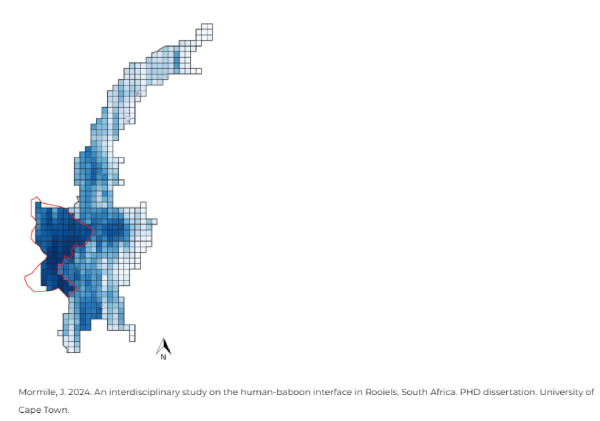
The Rooiels troop has a 5.78 square kilometre range¹, extending about 2km north of the village and 1 km south. The range includes sleep sites on the mountainside and along the Rooiels river, as well as low lying areas up to the shoreline.
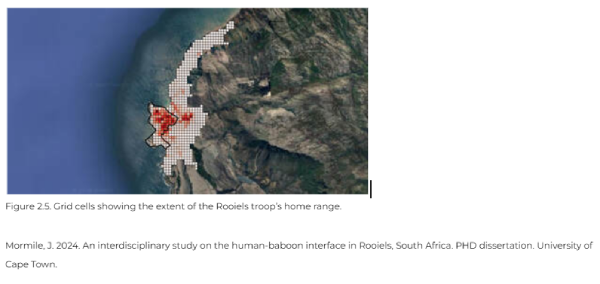
The map illustrates that they spend most of their time in the village, on Klein Hangklip and up the Rooiels river.
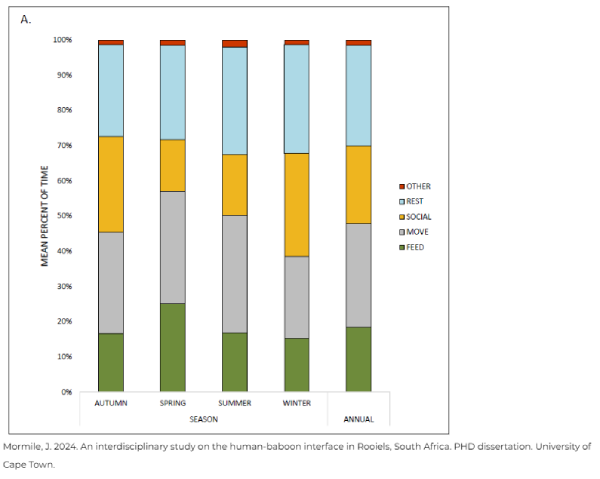
Baboons wake early and leave their sleep sites before starting their daily activities. We’re lucky to have hard data about this from a 2017-2019 study about how the Rooiels troop splits its time in pursuit of their priorities. They spent most of their time moving – 29.4% of their day. Resting is up next at 28.7%. 22.1% of the day was spent socialising. And 18.5% of the day was spent feeding on average. Their afternoon routine usually took them back in the direction of their sleep site for the night. These ratios adjusted seasonally – in spring the troop spent more time moving and feeding – taking advantage of new growth and abundance. In winter, they moved and fed less, and spent more time socialising with each other.
The Rooiels troop has 9 sleep sites in the mountains in and around Rooiels.
A 2017-2019 study showed that natural foods like fynbos, lawn grasses, exotic plants, bulbs/tubers, and bark made up about 80% of the troop’s diet. At the time of the study, one house left food out for wildlife, including baboons, which made up about 10% of what they ate. Human-derived food from houses or cars accounted for 2.1% of their diet, and food from unsecured bins was 0.96%. The rest of their diet consisted of occasional treats like shellfish and other unknown foods. The troop was also observed occasionally consuming clay along the road
They prefer the more nutritious Overberg Dune Strandveld fynbos found in lower lying areas over the Kogelberg Sandstone fynbos found on the mountain slopes.
Considering that the troop spent more time resting than feeding, they appear to be able to adequately meet their nutritional needs, even in winter.
Mormile, J. 2024. An interdisciplinary study on the human-baboon interface in Rooiels, South Africa. PHD dissertation. University of Cape Town.
This clay is added to the materials used to resurface the road and it’s believed it may provide benefits like relieving gastro-intestinal discomfort, detoxifying toxins and providing micronutrients and antibiotic benefits.
Mormile, J. 2024. An interdisciplinary study on the human-baboon interface in Rooiels, South Africa. PHD dissertation. University of Cape Town.
There are likely a few factors that contribute to the troop’s presence in the village. Like many other coastal baboons¹, they just prefer low lying land. Fynbos grows more densely at lower altitudes, and here they can forage for more nutritious strandveld vegetation as opposed to the Sandstone Fynbos found in the mountainous areas.
Human-related adaptations to the natural landscape also attract them, such as lawns, lush vegetation in watered gardens, shelter provided by buildings, easy access to water and occasional access to human-derived food. The roads in the village are liked by the troop, providing them easy pathways for travelling, as well as a buffet of fynbos, lawns and cultivated plants to snack on².
1 Hoffman, T.S. & O’Riain, M. J. (2011). The spatial ecology of chacma baboons (Papio ursinus) in a human-modified environment. International Journal of Primatology, 32(2), 308–328. https://doi.org/10.1007/s10764-010-9467-6
2 Mormile, J. 2024. An interdisciplinary study on the human-baboon interface in Rooiels, South Africa. PHD dissertation. University of Cape Town.
The troop spent an average of 3 hours per day in the village across all seasons. They tended to stay longer in spring (average 3.6 hours) and make shorter visits in autumn (average 2.2 hours).
Mormile, J. 2024. An interdisciplinary study on the human-baboon interface in Rooiels, South Africa. PHD dissertation. University of Cape Town.
Rooiels features some pretty extreme weather conditions at times. In the village, the baboons shelter from rain, wind, and sun using trees, covered verandas, balconies, and car ports
In the winter, when weather conditions are at their most hostile, the baboons tend to spend less time moving around – probably to conserve energy and warmth. In the absence of their preferred foods, they also use lawns as a winter fallback food source. It’s much easier to harvest than fynbos, and can just be plucked and eaten. This allows the baboons to feed quickly, and to limit the time they have to spend travelling in inclement weather.
Mormile, J. 2024. An interdisciplinary study on the human-baboon interface in Rooiels, South Africa. PHD dissertation. University of Cape Town.
Yes. The number of incidents where baboons accessed human-derived foods from houses, cars and bins was tracked for the period March 2017 – February 2018. 39% of all these incidents occurred in January 2018. The holiday period provides many more food opportunities for baboons to exploit. The influx of people means more properties housing potential food rewards, more people in town and bins filling up more quickly. In addition, holidaymakers are unlikely to be as well-informed and disciplined about avoiding situations where a baboon could exploit a food opportunity.
Mormile, J. 2024. An interdisciplinary study on the human-baboon interface in Rooiels, South Africa. PHD dissertation. University of Cape Town.
▸ 3. Baboon Physiology (14)
It’s one of the largest of all monkey species – large males can weigh up to about 45 kilograms, and be 1 metre in length. The females are much smaller – about half the size.
In the wild, they can live to around 35 years.
This happens only in female baboons, and it’s a sign that she is fertile and ready to mate. The swelling and coloration disappears once she has passed the peak of her fertility cycle, or if she becomes pregnant.
In the Rooiels troop a fertile female baboon reproduces about once every 20 months, which is similar to the interval found in troops who do not interact with human habitats. She will be pregnant for six months, and feed her baby for about 11 months before weaning and again becoming sexually receptive. However, if an infant baboon dies before it’s weaned, the mother will become receptive to mating sooner, and therefore will have a quicker reproductive cycle. A study of the Rooiels troop showed that here, the period between births was 20 months on average¹.
The mother of a newborn has quite a job on her hands – she needs to feed well to produce milk, and has to do it with three limbs, since a newborn doesn’t have enough strength to cling to her belly while she is foraging, so must be held in place. Luckily the father will often help out and look after the baby while the mother feeds.
1 Mormile, J. 2024. An interdisciplinary study on the human-baboon interface in Rooiels, South Africa. PHD dissertation. University of Cape Town.
While a baboon’s sense of smell is somewhat better than a human’s, it isn’t their primary sense. They rely primarily on sight to spot opportunities and danger.
Baboons rely on sight as their primary sense for vigilance against threats, social cues and spotting food opportunities. The males routinely act as lookouts for the troop. They can see better than most carnivores (eg. leopards or dogs) in daylight, but their vision is not specialised for night vision.
They have trichomatic vision, which means they can see reds, greens and blues – similar to humans. This helps them identify ripe fruits, young leaves and potential predators in their environment. Their forward-facing eyes allow them to see with binocular vision, which gives them the ability to gauge depth and distance – useful for navigating rocky terrain, climbing and jumping.
Their eyesight is sharp enough to detect movement at a distance, and they have broad peripheral vision, so they are well equipped to detect threats while foraging.
Cheek pouches are large, expandable storage compartments for food. These pouches allow them to gather food quickly and eat at a safer or more comfortable location.
They can reach speeds of up to 55 km/h (34 mph) in short bursts, especially when fleeing from a predator. That makes them faster than Usain Bolt (top speed 44 km/h (27 mph)). Their extreme agility and ability to do quick turns, jumps and climbs over rough terrain makes them highly capable of escaping danger.
A mature male’s canines can be 4-5 cm long and are most often put to use as a display tool. Either a threat display to ward off a potential predator, or a visual display of dominance and strength. A wide-mouthed yawn exposing those fearsome fangs is often enough to prevent a battle among males. And it can be irresistible to the ladies. Should a male have to fight for rank, or defend the troop against a threat, their canines are very effective weapons, and can inflict a grievous injury. Lastly, they are very practical aids to process tough foods like bark or shells.
Older baboons inevitably experience worn down teeth after years of breaking down tough vegetation, often mixed with gritty sand. Most baboons over ten years old will have flattened molars to some extent. They are able to adapt by adjusting their array of foods. Aside from species with teeth-replacement adaptations such as sharks, alligators and rodents, sadly all wild animals who use their teeth to process food will go through this natural ageing process.
There is no recorded case of a baboon transmitting a disease to a human being in South Africa.
There are no cases of rabies transmission to humans from baboons or monkeys in South Africa¹.
¹ National Institute of Communicable Diseases. 2015. Prevention of rabies in humans. https://www.nicd.ac.za/assets/files/Rabies%20A1%20posterinfographic.pdf.
Chacma baboons have long and strong tails, which they use for balance when climbing or running. Unlike some monkeys, their tails aren’t prehensile, and can’t be used to grip onto objects like tree limbs.
The tail can also be a subtle communication tool.
- A relaxed, downward tail shows that the baboon is at ease.
- A raised tail hooked over the back shows excitement or playfulness.
- A tail tucked between the legs is a sign or submission or anxiety.
- A stiff, horizontal tail indicates tension – the baboon may be sizing up a potentially dangerous situation.
- A tail held high and stiff indicates dominance or a warning.
- A rapidly flicking tail means irritation or annoyance.
Yes, baboons have opposable thumbs which allows them to grasp objects – important for things like foraging and climbing. Watching a baboon carefully pick through the fynbos shows how dextrous and precise they can be with their hands.
▸ 4. Baboon Society (22)
Chacma baboons live in complex, hierarchical social groups, with a dominant alpha male and female at the top, and subordinate members below. Female baboons are born into their rank, which remains static for their whole lives, and is passed down to their offspring. As they approach adulthood, males will either find their rank in their home troop through challenges for dominance, or leave the troop and attempt to join another. The reign of an alpha male is relatively short-lived, shifting to another male every 2 to 5 years on average, although this can vary depending on the troop and the circumstances. The longer the tenure of the alpha male, the more stable and less stressed the troop is.
The troop forages together. Dominant individuals monopolise the best food, and do not share it with others, even their own infants.
The group relies on vigilant sentinels to protect and warn against predators. They will attempt to flee from danger, but if attacked, the whole troop will fight back against an aggressor, with males leading the vanguard.
Baboon are caring parents – both the mother and father provide nurturing and protection for their offspring. Aunties and platonic male friends of the mother also help out with child care.
Strong social bonds are reinforced daily through communicating, grooming and playing, with alliances playing a key role in maintaining relationships and navigating conflicts.
Typically a female will give birth to only one infant, although cases of twins have been recorded. A newborn baboon has black fur and a pink face, and is the object of much interest, care and attention from the whole troop. Other females will often pay a toll to the mother (in the form of a grooming session) in order to get close to an infant.
A newborn weighs about 1 kilogram at birth. For the first few days, the mother will use her hand to support the newborn as it clings to her belly, until it develops enough strength to hold on for itself. This position provides protection for the infant, and easy access to milk.
Infant baboons develop quite slowly. The newborn drinks only their mother’s milk until they are about 3-4 months old. At this age, they will be able to ride on their mother’s back, and will sample their first solid foods like grass and flowers. By the time an infant baboon is one year old, it will be fully weaned.
Infants stay close to their mothers, but also start exploring the immediate environment, trying out their climbing skills and playing with other young baboons. Their mothers are highly protective, and will hold, shield or flee with their infant in the face of danger. Or if forced to, they will fiercely defend them against a threat. Males form bonds with specific infants, whose mothers they have mated or formed a platonic friendship with. They will allow the infants to clamber over them, protect them from threats and sometimes groom them.
A baboon is considered a juvenile from ages 1-5. After a year, their hair starts to lighten to a brownish gray colour, they go through a growth spurt, and grow by about half a kilogram every three months.
Life is all about play for juvenile baboons. They hang out in groups of similar age and have a lot of boisterous fun. It’s not just about entertainment though. Play hones their physical strength and skills, and also teaches them valuable social lessons.
Older juveniles will take on baby-sitting duties for newly weaned infants, and will protect them if a fight breaks out in the troop.
These are also prime years for learning what is safe and dangerous, which foods are good or not, and how to successfully navigate the social rules of their troop.
Adapted from https://www.livescience.com/57588-baboon-facts.html and https://baboonmatters.org.za/baboons/understanding-troop-hierarchy/
At about 5 years old for a female, and 7-8 for a male, a baboon is considered to be a sub-adult. During these ‘awkward teenage’ years, they will take on all the physical characteristics of an adult baboon, and life starts to look very different for male and female baboons.
All sub-adults will start to become braver and more independent, but they still need the protection of the troop. They also become more astute at observing the hierarchy and social rules of the troop, avoiding trouble and figuring out their place
For females, who stay with the troop they were born into for their whole lives, this means acceptance of their rank, forging stronger bonds with other females and making the most of the opportunities their rank affords them.
For a male, this is a much more tumultuous time. Physically he undergoes a transformation – he grows into his full height, his snout lengthens, his chest and neck fills out, and his canines grow long and sharp.
He distances himself from his mother, and starts to form bonds with other young males, with whom he practices his wrestling and fighting skills. He starts to figure out who in the troop can be challenged, and who to avoid. Eventually he will have to decide whether to leave the troop, or to stay and either challenge the dominant male or accept a lower rank.
Females are born into their position within the troop, keep it their whole lives, and pass it on to their daughters. They form strong bonds and friendships within a troop, and groups of females with babies tend to stick together to give each other support and share child-care duties. However, there are strict boundaries to observe depending on the female’s rank. The alpha female will always monopolise the best food and resources, while the lowest ranking female will have to accept what is left. Lower ranking females routinely groom females who are higher up the hierarchy.
If she is not pregnant or lactating, every 30-40 days, a female baboon comes into estrus, and her rear end swells up and becomes pink, to advertise that she is fertile and receptive to mating. Females prefer to mate with the strongest and most dominant male in the troop in general, but there are always exceptions.
The gestation period for a female Chacma baboon is six months. If her infant survives, she will become sexually receptive again about a year post-birth.
Peak reproductive years are 7-15 years old. Once a female baboon reaches around 20, her fertility starts to decline, although it’s not unheard of for baboons in their early twenties to give birth. Chacma females don’t go through true menopause, but older females will rarely conceive.
Some male baboons do choose to stay in their natal troop and don’t challenge for the alpha position. This is perhaps because they have strong familial bonds which they prioritise above increased rank. They may also choose to stay if they spot opportunities to mate while occupying a lower status, for example if they have a strong relationship with a lower ranking female. If they have already mated with one or more females, that may be another incentive to stick around to protect the infants. Others just may not have that competitive edge and do not see the benefits of dominance as outweighing the safety and familiarity of their home troop.
It’s not very common, but sometimes an adult male will seek to take over the alpha position in his home troop, especially if the current alpha dies, goes missing, is aged, weak or distracted. The takeover could be as a result of direct combat, or through strategic alliances, especially with the females.
When a male baboon reaches 7 or 8 years old, he may leave his home troop and set out to find a new one – he becomes known as a ‘dispersing male’. This behaviour is vital for the overall health of the species, as it introduces genetic diversity into different troops, who otherwise would bear the brunt of inbreeding.
This quest puts the young male into an incredibly vulnerable position. For the first time in his life, he will be all alone, and without the protection of the troop. He has to find his way to a new troop, and is at risk of being labelled as a ‘rogue’ who becomes an easy target for those who don’t understand or sympathise with his situation. If he does find another troop, he may be rejected with or without violence. If he does find a troop who tolerate his presence, he will be without status, and will either need to fight to establish dominance, which can be extremely dangerous. Or he can create alliances and carve out a position where he may be able to mate opportunistically. Either way, it’s a lot of work and risk, with no guarantee of success. If he does successfully join a troop, he may be able to rise to the position of alpha with time, or he may decide to disperse once again, and look for something better. It’s estimated that only 10-30% of dispersing males successfully find a stable spot in a new troop.
Lower ranking males generally have less access to resources, like food and mates. They may also be subjected to aggression, bullying or social exclusion from higher ranking males, to whom they generally defer.
Lower-ranking males still participate in troop activities like foraging, sentinel duties and defending the troop. However, they might not hold much influence in group decisions about where to rest or which areas to forage in.
Their best tools are patience and social intelligence. By grooming, socialising and forming alliances with other troop members, especially higher ranking males and females, they may secure protection from bullying and occasional opportunities to mate.
While lower-ranked males may not have access to all the privileges of their higher-ranked counterparts, they still play an essential role in the troop. They help to maintain social cohesion, by acting as mediators and peacemakers. Often they form strong bonds with lower-ranked females and infants, and act as their protectors if they are under threat.
Most of the time the alpha has proven his strength and capability by fending off other contenders to earn his place, although some alpha males may just walk into the job if the previous alpha has died or gone missing.
He, more than any other baboon in the troop, has the job of watching over and protecting the females and infants. He also claims rights to mate with the receptive females in the troop.
He provides discipline, order and routine to the troop. The killing or disappearance of an alpha causes chaos in the troop’s cohesion, and can result in smaller fission group forming and the troop’s patterns becoming disorganised and unpredictable.
His position is never completely secure and he can expect to be challenged by other males from inside or outside the troop sooner or later. He has to maintain alliances with lower ranked males, who will back him up if he is physically challenged. He also has to have good relationships with the females to earn their loyalty and willingness to mate with him.
Eventually he will lose his alpha status, and will have to adjust to a new social standing.
An alpha can be displaced by a younger, stronger baboon, in which case he’s unlikely to be able to reclaim his position. He may also fall from grace if he loses the trust or support of key members of the troop. It’s possible, but unlikely that he would be able to pull some clever social manoeuvres to get back on top temporarily. Either way, the position of alpha is always temporary, and in baboon society, the alpha male switches out quite often – typically every 2-5 years.
He’s relegated to a new, lower-ranked position in the troop and loses the food, resources, mating and other privileges reserved for the alpha. He may now become subject to aggression, bullying or social exclusion from higher ranking males in the new hierarchy. If he has made close enduring bonds prior to being toppled, these should hold him in good stead, providing friendship, social support and comfort, and he may still be able to wield valuable social influence in the troop. Often he will become much closer to the females, juveniles and infants who he has fathered.
Around age 20-25, baboons start to enter what can be termed old age. Like humans, baboons start to physically decline, with a gradual loss of strength and mobility. They also become more susceptible to injuries and arthritis, and their vision and hearing can diminish over time. Males become less aggressive and their social status may decrease.
Their abilities as mentors and social stabilisers become priorities, and they spend more time socialising, grooming and bonding with the troop. Baboons without enduring social bonds may suffer from loneliness and elevated stress levels.
The death of a troop member can be a significant event for the troop, especially if they had a long-standing role as a leader, guide or social stabiliser. It can result in social disruption, as the troop’s hierarchy must reorganise itself, which may involve challenges for high status positions.
The death of a mother or primary caregiver can be especially hard on young baboons, as they lose their primary source of care and protection. Other members of the troop may step in to care for the infant or juvenile, though this can lead to uncertainty for the young baboon’s survival.
Baboons are known to exhibit signs of grief when they lose a troop member, involving vocalizations, physical grooming, or even a period of mourning. Members of the troop may show signs of distress, and there could be a temporary drop in group cohesion or coordination.
In a 14-year study of chacma baboons in Botswana’s Okavango Delta, researchers found that like in humans, baboons who had suffered losses were found to have elevated levels of stress hormones (glucocorticoids). The study further indicated that after the death of a family member, females compensated for their loss by “reaching out” more than usual to other females. They increased their grooming rate and broadened their circle of grooming partners — even breaking rank to form alliances with those beneath them. Researchers believe that the contact serves as a coping mechanism for the baboons, as their glucocorticoid levels dropped significantly just after grooming¹.
1 https://www.pbs.org/wnet/nature/murder-in-the-troop-inside-chacma-baboon-society/2051/
The death of a juvenile or infant affects the emotional well-being of the troop. The whole troop shows signs of distress, with vocalisations and grooming of the dead baboon. It is particularly traumatic for the mother, who may carry her child’s body with her for days. Other females with whom she is strongly bonded will offer her support, and they may step in to help care for any of her surviving offspring.
Yes, baboons adopt infants and juveniles, particularly if they are too young to independently care for themselves. Adoptive mothers provide food, grooming, and protection to the orphaned infant, and the troop generally supports this behavior, as it helps maintain social cohesion. However, the success of adoption can vary, depending on the individual circumstances and the resources available within the troop.
An adoption was observed in Rooiels in February 2018, when a mother and her 4 month infant were attacked by 2 dogs. Sadly, the mother had to be euthanised. Her infant was adopted by another female who had an infant of the same age. She carried and nursed him alongside her biological son. Despite this, the adopted infant’s health declined over 4 months, and one day he could not be found and was presumed dead¹.
1 Adapted from an article by Dr Joselyn Mormile in the 2018 Breeze magazine.
Baboons are not territorial. Their home ranges are based on the extent the baboons are prepared to travel to meet their dietary needs. If food availability changes – for example due to fire or drought, the boundaries of their range may change, and cause troops to come into contact with one another. Whilst wary of each other, each troop will avoid conflict if it can do so.
Chacma baboons exhibit several remarkable cognitive abilities which indicate their complex mental capacity and adaptability in both individual and social contexts.
Chacma baboons are capable of social learning – they observe and learn new skills from watching others. This includes learning to use tools, find food, or solve problems¹.
There is some evidence that they have a basic understanding of the intentions and perspectives of others, otherwise known as theory of mind. They assess social cues and behaviour, and adjust their actions accordingly².
Baboons exhibit problem solving skills, such as tool use e.g. using stones to break open hard shells. This indicates they have the ability to plan, and to manipulate their environment³.
They have excellent spatial memory, which allows them to remember locations of food, water, and other resources in their home range. This memory is crucial for navigating their environment and accessing resources⁴.
Baboons have passed basic versions of the “mirror test,” which assesses self-recognition. This suggests a relatively high level of self-awareness⁵.
Baboons display emotional intelligence, by gauging the emotional states of others, such as recognizing fear, aggression, or contentment, and adjusting their behavior accordingly⁶.
1 Thierry, B. (2000). “The primate order.” Primate cognition, Oxford University Press.
2 Dunbar, R. (1998). “The social brain hypothesis.” Evolutionary Anthropology: Issues, News, and Reviews
3 Yerkes, R. (1943). “The behavior of the chimpanzee and other apes.” The Journal of Social Psychology.
4 Dunbar, R. I. M., & Shultz, S. (2007). “Understanding primate brain evolution.” Philosophical Transactions of the Royal Society B: Biological Sciences, 362(1480), 649-658.
5 Bremner-Harrison, S., & Broome, A. (2006). “Self-awareness and social knowledge in wild baboons (Papio ursinus).” Animal Cognition.
6 Cheney, D. L., & Seyfarth, R. M. (2007). “The evolution of language.” The Primate Mind: Built to Speak.
For Chacma baboons, mating is more than just a quick encounter -it’s a complex social game filled with flirting, competition, alliances, and sometimes, long-term friendships.
When a female comes into her fertile period, her rump swells up and turns pink. It’s a sign that’s impossible to ignore and triggers some interesting behaviour in both males and females.
An interested male will try to charm her. He may follow her around and give her meaningful stares. He might indulge her with a nice grooming session to build trust, or make a show of carrying infants around to show he is a good caregiver.
The female may receive this by playing hard to get, ignoring or even rejecting his advances. He needs to prove his persistence and social skills. If she is interested, she may flash her eyebrows at him, or strengthen her bond with a male through grooming. And if she wants to dispense with the niceties, she simply positions herself in front of a male and presents him with her swollen rear end.
Most of the time, the alpha male is the one who gets to mate. He monopolises the fertile females and tries to restrict other males from mating with them.
Considering that baboon society is so dynamic, the alpha’s domination of mating rights is not set in stone. If a lower ranking male has a strong bond with a female, they might mate when the alpha’s back is turned. Or sometimes a lower-ranking bonded couple is openly tolerated in the troop. Females may mate with several males, which reduces the risk of them harming her infant at a later stage. And sometimes a specific female is just not interested in the alpha male, or vice versa, in which case other mating opportunities arise.
Baboons fight for power, survival, and resources, but their conflicts are not mindless—they follow clear social rules. While aggression is common, most disputes are settled through displays and intimidation rather than full-on violence.
Male baboons fight to achieve dominant positions in the troop hierarchy. Even if they are not trying to take over the alpha position, they may fight to get a higher rank, and the increased privileges that come with it. But challenges for the alpha position often lead to intense battles between individuals or groups.
The males may also fight over a female. This is usually limited to chasing each other and making threatening displays.
Mothers, and sometimes males will fiercely defend their young if they are threatened by another baboon.
There are also petty squabbles, which can get physical, like fighting over high-value food, personal grudges or irritation. These are usually short-lived scuffles.
When serious fights break out between males, the females ensure that they and offspring don’t get caught in the crossfire by rapidly putting distance between themselves and the aggression.
Over and above the basic benefit of removing parasites, debris and dead skin from a baboon’s coat, grooming is a primary form of bonding, and forming and maintaining friendships. For the baboon being groomed, it’s a highly pleasurable, comforting and relaxing experience which lowers their levels of stress.
It’s also a form of currency that a lower-ranking individual can trade with to get close to another baboon, who may in the future become a protector, mate, ally or friend.
All social mammals, including humans, exhibit six universal emotions: fear, disgust, anger, sadness, joy, and surprise, with varying degrees of nuance and complexity. Some baboon emotions suggest depth and complexity which goes beyond simple, in-the-moment reactions.
Fear is easy to discern in baboons, through their display of fear grimaces, vocalisations and flight from danger. It can become internalised, and manifest in anxiety or avoidant behaviours, like avoiding eye contact or making nervous gestures when near a dominant individual.
Baboons display simple disgust behaviours, like sniffing and rejecting rotten foods.
The emotion of anger is displayed clearly in competition for food, dominance or mating privileges. But baboons can also hold grudges, and seek revenge at a later time, which suggests they have long-lasting emotional states, and complex emotional processing.
Sadness is most clearly seen in baboons with the loss of a troop member. Collective vocalisations, increased grooming and agitation in the troop are the most visible indications. They may also go through a period where the troop appears to exhibit ‘solemn’ behaviour where they do not carry out their standard daily routine, deprioritising their primary activities in favour of increased social bonding activities.
Joy and happiness is most obvious in baboon play, in which their enjoyment and exhilaration can be seen and heard. Grooming is another activity which generates enjoyment and contentment, and can include affectionate gestures such as nuzzling or a rhythmic ‘purring’ vocalisation. Grooming may turn into play when tickling is involved, and may result in panting or breathy “ha-ha” sounds which sound like human laughter, or a relaxed show of teeth which is a baboon’s smile.
A baboon exhibits surprise when startled by jumping, stiffening their bodies or rapidly looking around to assess the environment, and may lead to alarm calls and flight. Their need to evaluate their surroundings often means that a surprise can quickly turn to curiosity and an investigation into the object that has caused surprise.
Other observations suggest that baboons also experience a broader range of emotions like affection, trust, jealousy, frustration, empathy and awe.
▸ 5. Baboon Communication (3)
Baboons constantly communicate with each other to maintain contact as they forage, to signal mood, or to alarm for danger.
Lip smacking: Baboons rapidly smack their lips together as a friendly welcome or sign of reassurance. It is their way of smiling and showing affiliation.
Rhythmic grunts: Soft, low rhythmic grunts are a friendly greeting when one baboon approaches another.
Grunting: Adult males make a deep and soft “huh huh huh” sound as a signal of dominance. This is often followed by a two-phase bark.
Two-phase bark: A loud “WAAA-hu” call, repeated every few seconds. It’s an aggressive warning call to other males or approaching predators.
Screeching: Male and female baboons of all ages emit high pitched screams as a defense tactic against antagonistic males.
Yakking and clicking: As a signal of retreat and pacification to a threat, sub-adult and adult baboons issue a short and sharp “yak” while juveniles and infants make a chirping or clicking sound.
Shrill bark: Except for the adult males, all troop members make an explosive single alarm cry when there is immediate danger. It’s a sign for the troop to flee.
Doglike bark: This is a call made when troop members are separated from the troop, and has a higher pitch than the shrill bark. It can be interpreted as ‘where are you?’.
Chattering: Juveniles make rapid nasal murmurs as a sign of enjoyment and contentedness.
Purring: Low-frequency vocalizations that can resemble a purring sound, particularly during moments of contentment or social bonding. Often heard when baboons are grooming each other or resting together, indicating a sense of relaxation.
Laughing: A series of short, breathy exhalations, almost like a “ha-ha-ha” or “heh-heh-heh” that can vary in intensity. This sound is commonly heard during playful interactions, especially among younger baboons or when baboons engage in friendly social behaviors like grooming or chasing.
Baboons have very expressive faces, and use them extensively to signal intent and mood. This in combination with social context, vocalisation and body language gives them a rich social communication skillset.
False yawning: Male baboons do an exaggerated, wide-jawed yawn as a dominance display. This shows other males the size and sharpness of their canines as a warning not to challenge the yawner.
Fear grimace: All baboons display this expression of fear or worry. They pull their lips back and expose their clenched teeth as a sign of submission or respect.
Raised eyebrows: It can be used in conjunction with staring, or a canine flash, but even without, raised eyebrows from one male to another represent a challenge or threat.
Flashing eyebrows: Rapid eyebrow raising is a signal from a sexually available female, designed to elicit interest from a male.
Challenge staring: Male baboons fix their rivals with a menacing stare. To enhance the effect, he could also raise his eyebrows and move his ears back, revealing different coloured hair under his eyes. All of this sends a clear message of ‘don’t mess with me’.
Flirtatious staring: A male who is interested in a fertile female may fix her with a prolonged and appealing stare.
Frowning: A furrowed brow and narrowed eyes can indicate irritation, confusion or concentration.
Close-eyed yawning: A sign of relaxation.
Smiling: A relaxed show of teeth, displayed in non-aggressive situations like grooming or playing, and sometimes shared between mothers and infants in moments of closeness.
Eye narrowing: Partially closed or narrowed eyes, sometimes with raised eyebrows, are a sign of suspicion, often in social situations.
Canine display: Sometimes presented by a lower-ranking male to test a male of higher rank who is consorting with a female. A quick flash of the teeth serves as a threat
Rapid glancing: This involves turning the head away from a threat display and breaking eye contact in an effort to defuse the tension.
Greeting: When two individuals meet, they touch muzzles or sniff nether regions as an amiable ‘hello!’.
Relaxed posture: A relaxed, upright posture with a soft body stance. It signals peacefulness and friendliness.
Huddling and touching: Leaning on another baboon, or gently touching is a friendly gesture that signifies affection or reassurance.
Social presenting: A submissive act in which a female or juvenile exhibits their hindquarters to another baboon, or sometimes even a human. It is a gesture of respect.
Social mounting: generally a response to social presenting. Though it resembles a sexual mount, the baboon has no real intention to mate. In most instances, social mounting signals friendly reassurance.
Standing tall: When a baboon stands upright and puffs up its chest it is a display of authority and confidence.
Pounding: Using hands or feet to drum on the ground or an object is a sign of frustration, aggression and a warning to others.
Crouching: Lowering the body to the ground, often with the front limbs bent means submission and deference.
Defecating or urinating: A sign of fear when seen in conjunction with other fearful behaviours or when a baboon is confronted or cornered.
Running with tail held high: A sign of fear.
Leaning forward: If a baboon leans its body slightly forward, with its arms extended and ears alert it means it is curious or interested in something.
▸ 6. Threats to Baboons (2)
Baboons are often obliged to cross dangerous roads to access different parts of their range, but they also choose to regularly linger on and around roads where they are often exposed to danger or death – particularly the infants. It’s theorised that baboons enjoy the warmth that the road surface provides, particularly in colder weather. It may also be a space which meets all three of their priorities – a space safe from predators, where the family can socialise, play and groom, as well as feed on natural roadside vegetation, squashed insects and litter thrown from passing cars or public bins..
We may not know the exact reasons, but baboons clearly choose to spend time on roads. They don’t have great road sense and don’t understand what a hooter is. The infants are particularly vulnerable. Please make sure you drive responsibly and slow down in areas where any wildlife frequents the roadways.
Data collected between 2016 – 2020 found that only 44% of Rooiels’ infant baboons made it to their first birthday. Infants made up 75% of all troop deaths, with most dying at around 4-5 months old after being hit by cars on the R44/Clarence Drive. In that time, eight out of ten adult females lost at least one infant.
The Rooiels infant mortality rate of 56% is significantly higher than that of troops in more natural environments, where it ranges from 28-45%¹. However, since the study concluded, infant mortality appears to have declined, suggesting that this rate may fluctuate over time.
1 Mormile, J. 2024. An interdisciplinary study on the human-baboon interface in Rooiels, South Africa. PHD dissertation. University of Cape Town.
▸ 7. Encountering Baboons (12)
Remember not to walk around the village carrying food. If you’re walking with food from the shop, restaurants or with a picnic, make sure it’s packed away in a backpack, container or fabric bag to minimise the chance that a baboon will detect it.
If you don’t have food on you
Remain calm and either stand still or just continue walking, without making eye contact. The baboons will just ignore you. Don’t purposefully get too close. Generally if you’re on one side of the road and the baboons are on the other, they won’t react to you.
If you have food and the baboons want it
To avoid a confrontation, you need to put some distance between you and the food. Calmly drop the food and take a few steps back.. The baboons will lose interest in you and focus on the food.
Dogs must be on leashes at all times, both for their own safety and the safety of other dogs and wildlife in the village. Provided your dogs do not chase or react aggressively towards them, they will be ignored by the baboons. Just make sure to keep your distance.
If your dogs are reactive to baboons, rather turn around and take a different route. If the baboons are heading towards you and there is no alternative but to meet them head on, stop on the side of the roadside and calmly control your dog by holding onto its collar or harness. The baboons will briskly pass by and will not linger near a reactive dog.
If there is enough space, just continue riding past at a steady pace. If the baboons are scattered across your path, don’t ride through them. Either stop and wait for them to move off, or find an alternative route.
The baboons do spend time on the beach, so if you eat food while you’re there, keep a look out for any approaching baboons. There is a risk that they will be attracted by the sight of your food.
It’s best to keep your picnic in a lockable box, and only serve up food as you need it rather than laying out a spread.
If you see the baboons approaching, and there is time, calmly and quickly pack the food away and secure it. Move everyone away from the cooler box/container.
If there’s not enough time to secure the food, put it down on the ground and quietly move away. Hiding it under a towel or blanket won’t work – it’s better to just distance yourself from the food.
Don’t panic, scream or try to scare the baboons away from your food. This will only escalate the situation and make it worse.
When you are in an area baboons frequent, always lock your doors and close your windows – whether or not you’re inside the vehicle. Baboons know that cars are often stuffed with goodies, and they know how to open car doors. The easiest thing is to prevent them from accessing your vehicle in the first place.
If a baboon gets into your empty vehicle, ensure there is a clear escape route, move away, and wait for them to exit by themselves.
If you are in the car when a baboon gets in, remain calm and quiet, and slowly get out of the car if possible. Leave the door open behind you, and wait for the baboon to exit when they are ready. If you can’t exit the vehicle, open as many doors and windows as you can, let the baboon complete its search for food, and wait for it to leave of its own accord.
Do not corner, threaten or confront the baboon – this may provoke an aggressive response, or a mess in your car.
If the baboons come onto your plot, make sure all your windows and doors have mechanisms to limit how far they can open, so the baboons can’t access the house. Remain calm.
If you are outside, and there’s no food around, just carry on with what you were doing, and the baboons will do the same. As long as they don’t see food, or a way to enter your house, they will move along when they are ready.
If you are eating outside, get up, take your plate inside and secure the door behind you. It’s best to serve the food inside and take individual plates out, rather than set up serving dishes in an outside space.
If they have already got their hands on some of the food, get everyone inside, and let them take the food. If there is a clear escape route, you can calmly encourage them to leave.
Do not panic, scream, tussle with or try to retaliate against the baboons – this will escalate the situation into chaos.
If a baboon enters your home, stay calm and do not panic. It is looking for food, and does not want to get into a confrontation with you. If you have dogs, secure them away from the area the baboon is in.
Ensure there is at least one clear exit route. Keep your distance until the baboon has filled its cheek pouches and tucked what it can under its arms, then firmly encourage it to leave through the exit point.
Do not scream, get too close or make sudden movements or you will just panic the baboon and cause it to defecate or urinate.
If baboons are in your house and you become nervous, call someone to assist.
If a baboon comes in while you’re eating at a restaurant, stay calm and quiet, and encourage others to do the same. Alert the restaurant staff if they aren’t already aware.
If you have personal items on the table like phones, calmly pick them up and move away from the table. Don’t block the baboon’s exit route. If you don’t know where the exit route is, move to the side or corner of the space where you are least likely to obstruct an escape. Restaurants in areas with baboons will have a plan of what to do, so let the staff handle the situation. They will ensure the baboon leaves with the minimum of disruption.
Do not feed the baboon, get into a tussle over food, try to intimidate, retaliate, chase or corner it. Don’t panic, and try to encourage other patrons to behave calmly and sensibly.
Firstly, it’s important to be calm and clear-headed about the situation. A baboon who has entered your car or home does not want to get into a fight with you. In fact, he is probably more scared of you than you are of him. But he does want a reward for the risk he has taken. Make peace with the idea that you’ll likely need to sacrifice some food in order to evict a baboon with the minimum of disruption and mess.
Next, make sure there’s a clear and unobstructed way for the baboon to escape.
Gauge the right time to act. Your very presence is likely to send the females and lower ranking baboons into a panicked exit. A more dominant baboon may be more determined to get a reward before he leaves. Wait for him to gather up some food, and then make your move.
Stand tall, put your shoulders back and hold your head high. Then calmly and assertively walk toward the baboon, holding up your arm, a broom or something else to signal that he must leave. Make sure your approach doesn’t force him away from, or block the escape route. Be assertive and sure of your intention.
Use a loud, commanding voice to say “OUT!” or “NO!”, but don’t shout or scream. You could also clap your hands. Continue to move the baboon towards the exit.
If the baboon bares its teeth in a fear grimace, it is scared. Other signs of fear include running with the tail straight up, high pitched screams and frantic movements and defecating or urinating. Do not allow any of this to deter you, and continue to chase it out.
Being very sure of your intention, using calm, strong body language and following through should ensure that the baboon leaves. If the baboon refuses to leave, it may not be convinced by your body language and could take advantage of any hesitation. Often, they will simply watch your attempts to chase them away without reacting. They may even display a fear grimace but remain stubbornly in place.
This is sometimes misinterpreted as ‘aggression,’ but when the situation is examined more closely, it often turns out that the baboon didn’t actually act aggressively—it just didn’t retreat. It’s important to distinguish between genuine aggression and normal baboon behavior. Feeling threatened does not necessarily mean the baboon has behaved aggressively.
If in the end you are unsuccessful or nervous, call someone to assist.
The most important thing is to remain calm. If you become hysterical, angry, or start yelling, you are likely to frighten the baboons. This can cause them to immediately defecate and react fearfully or protectively, especially if their family is nearby. It’s in your best interest to stay composed and avoid provoking them. Reacting poorly can quickly escalate the situation and make it more difficult to manage.
If baboons are fighting in your vicinity, bring all people and pets inside, and make sure your windows and doors are secure until the fight has died down. Baboon fights and chases are intense and can be unpredictable, so make sure there is no possibility of you and your loved ones getting caught up in the chaos.
Call any member of the Conservancy who will take the correct course of action.
Get in contact with the Conservancy at rec@rooiels.org.za.
▸ 8. Living With Baboons (9)
Baboons enjoy gathering and feeding on lawns, particularly in winter. If you have a lawn, it will attract the troop, as will vegetable gardens, fruiting trees, unsecured rubbish or open compost heaps.
Having food openly displayed in your home will attract the attention of the baboons e.g. fruit bowls.
Pet food or food left out for birds is a sure way to invite a baboon visit..
If the baboons have previously been successful at getting food from a house, they will try to repeat that success. It’s essential to consistently prevent access until they learn that it was a one-off.
If you live in Rooiels, it’s essential that your home is up to the job of preventing access by baboons. Read the page on how to baboon proof your home. If you need some help with this, please contact the Conservancy at rec@rooiels.org.za.
Secure your windows
You need to ensure that your windows don’t allow enough space for a baboon to squeeze through. You can:
- Add clear or traditional burglar bars to your windows, with spacing no greater than 6cm.
- Limit window openings with window catches at both top and bottom of the opening side of the window. Baboons can sometimes bend or break the window if it’s only secured at one point. Locklatch.co.za has some options, or ask at Gossip Corner restaurant in the CBD for sturdy stainless steel limiters.
Secure your doors
- Trellidoors, security gates and shutters should have gaps no greater than 7cm.
- You can use extra-strength mesh-sliding doors or shutters to allow light and air in while keeping baboons and other wild animals out.
- All sliding doors should be fitted with a track guard so that doors cannot be lifted off their rails
- Also install a limiter on your sliding doors if you wish to leave them slightly open to facilitate airflow. Try Locklatch.co.za or ask at Gossip Corner restaurant.
- Install round door knobs on outside doors.
- Baboons can get through cat or dog flaps. Pet flaps that remain closed until they are activated by a collar worn by your pet are available.
Use sturdy external fixtures
Baboons love using buildings as playgrounds and vantage points. Investing in strong fixtures which can withstand this could save you money in the long run.
- Brackets on guttering should not be further than 300mm apart.
- Any outdoor plumbing, basins, showers, etc. should be secured with extra brackets.
- Fit TV antennas inside rather than on the roof.
- The arms of satellite dishes should be fitted with barbed wire, electric fencing, or wrapped with thorny acacia branches if you can find them.
- Use good, washable exterior paint so that dirty baboon hand prints are easily washed away.
Make sure your waste is secure
Baboons are attracted by trash, and must not be allowed to access it.
- If you can, store your rubbish inside until collection time on Monday morning.
- By law, your fixed bin or wheelie bin must be secured with a baboon proof device.
- If you have a compost heap, it should be in a baboon proof container.
If you are building from scratch…
- Make the most of the opportunity to plan and build a secure and solid home. This will pay dividends over time by reducing potential damage and stress.
- Use longer nails and screws, extra braces and stronger materials wherever you can.
- Install aluminium window frames which are much more resistant to the Rooiels weather, as well as baboons.
- Plan internal access to the house from the garage so you can unload your car stress-free.
- Avoid outside sills and ledges which offer purchase to baboons.
Using these tips will ensure that your house is not an easy-access area for the baboons. You need to be vigilant about using your baboon proof measures consistently – never leave an unsecured window or door open, even if you are in the vicinity, or pop out for a couple of seconds. Baboons are stealthy and quick, so make sure you don’t create a situation where they can get into your home.
- Electric fencing has met with mixed success. Baboons learn to vault over these wires and still manage to gain access to these homes. We would suggest you speak to some home owners who have employed this method before installing yourself. It is more effective on the building itself than on a perimeter fence. If you do install a fence on your property, please ensure that it does not surround your entire plot, so wildlife can still pass through.
- Vegetables and fruit do not grow well so near the sea, but if you do want to grow them, then you need to be sure to have a very securely covered, baboon proof growing area.
- Grow an indigenous garden with locally successful plant species. Your garden will not be seen as any more attractive than the surrounding natural areas.
Make peace with the idea that baboons will visit your plot either regularly or seldomly. They don’t understand that a specific plot is unfriendly to them, and will continue to use the routes and foraging or resting areas they find attractive. It’s less stressful for all concerned to ensure that your house is secure, and to enjoy the fact that your fynbos is being propagated with every baboon visit.
- Store food in closed places where the baboons cannot see it.
- Feed your pets inside, and don’t leave their bowls in outdoor areas.
- Don’t leave food like bird seed out.
- If you have a garage, unpack your groceries inside and with the garage door closed.
- Put your rubbish out shortly before it’s collected, and always in a secured bin.
- Always use your baboon-proofing mechanisms on windows and doors.
- Lock your vehicle if it’s parked outside.
Using these tactics consistently will send a message to the baboons that they have no chance of gaining a reward from your property. They will learn not to waste their time and energy investigating or trying to access your home.
It is essential to baboon-proof your dustbin, whatever type it is, and wherever it’s situated.
- Wheelie bins can be fitted with a locking mechanism. Bins with a preinstalled lock can be purchased from Overstrand Municipality.
- The fixed bins you see around the village are heavy enough not to be knocked over by the baboons, and can be locked with a simple carabiner available from the village shop. They are available from Primwood Products.
- Store food waste indoors until Monday morning, when the rubbish is collected.
Betty’s Bay Conservancy has a good article on different types of bins and locking mechanisms you can buy locally, with contact details. And pages 28-29 of this booklet from Baboon Matters has DIY tips for baboon proof bins and compost containers.
In general, Rooiels is a safe place for children to play outside, and a wonderful opportunity for future generations to observe and learn about living with wildlife. But unexpected or confrontational encounters between children and baboons can be frightening and create long-lasting anxiety. It’s important for both parents and children to be mindful of the baboons’ presence and to understand how to handle situations. Ensure that children are aware and educated about how to handle themselves around baboons.
First and foremost, ensure that children (and adults) don’t have food on them while out and about in the village. In the worst case scenario, if the child has food, and a baboon has already become fixated on it, they should calmly set it on the ground and back away. If children are out walking in the village, cycling, on the beach, in a vehicle, at a restaurant or inside the house when they encounter a baboon, please see the FAQs for each of those situations.
If children are playing outside, and the baboons are in the area, teach them to calmly and quietly go inside. Do not panic and rush them inside as this could create a fearful attitude in the child.
The general advice remains the same for everyone in all scenarios: remain calm, distance yourself from food, keep your distance from the baboons, do not corner them, and ensure there’s a clear escape point.
Interactions between your pets and the baboons will largely be dictated by your pet’s attitude toward the baboons. Baboons are not aggressive toward other animals, unless they are seen as a threat. They may show curiosity towards your pet if it is not aggressive, or simply ignore it.
Rooielsers have reported that their cats and the baboons manage to coexist peacefully, with the cats either making an exit when the baboons are around, or happily sharing space together.
If your dog is non-reactive, the baboons will not harm it, and they may even have a positive interaction with each other. Baboons will generally ignore a barking or aggressive dog which cannot get to them, and simply walk past.
If your dog chases or attacks them, they will try to escape, but if this is not possible, they’ll respond aggressively and fiercely to defend themselves. Do not allow your dog to get into a situation where it can attack the troop – both the dog and the baboons are at great risk of being severely injured or killed. Several adult and infant baboons have lost their lives in recent years through dog attacks.
Check if the baboons are close by before letting your dog out. If they are around, wait until they’ve passed by before allowing your dog out. If your dog is already outside when the baboons arrive, take it inside. Don’t leave dogs outside for long periods of time, especially if you are away from home. Baboons will avoid fenced properties when aggressive dogs are visible and barking, but will still enter when the dogs are not visible. This can result in an altercation if you dogs encounter the baboon unexpectedly.
If you are out walking your dog, see the separate FAQ for how to handle it.
Dogs are more dangerous than baboons. It is your responsibility to ensure that your dog cannot chase or harm our wildlife, and to ensure that they are under control at all times.
Fear is a common emotion expressed by people when they talk about or encounter baboons. It can arise for various reasons, some of which are complex and deep-rooted. Some even hypothesize that humans may have a primal aversion to baboons and other primates because they are so similar to us, yet not quite the same¹. This guidance is not intended to address deep-seated or trauma-based fear.
Baboons are a much misunderstood species. Much of the fear surrounding them stems from a lack of familiarity, negative publicity, or stigmatisation, but this can often be alleviated with knowledge, experience, and support. If you are fearful of baboons for any of these reasons, these approaches could help.
Read and learn about baboons. While people’s fear is real, it may not always align the reality of baboon behaviour and the actual danger associated with them. By learning about their behaviour, habits, body language, and interactions, you can better interpret your assumptions and make a more realistic assessment of the threat a baboon might pose. Reading the baboon material on the Rooiels website is a good starting point.
Humans are often disconnected from our primal instincts and reactions to animals. Most of us rarely encounter wild animals in our daily lives. So, when an unexpected encounter occurs, reacting with fear is completely natural. If we are armed with knowledge and mindfulness, we’ll be better prepared to handle situations calmly and confidently.
Put yourself in control. Humans tend to struggle when they feel a lack of control or predictability. The fear that something may happen at any time, in any place, can lead to stress and anxiety. Putting measures in place to limit unpredictable encounters with baboons creates environments and situations where you can feel relaxed and in control.
Baboon-proofing your home (and religiously using your baboon-proofing mechanisms) pays off by allowing you to relax, knowing there’s little likelihood of baboons entering.
Understanding how to handle encounters with baboons when you’re out and about helps you assess situations and know how to deal with them successfully.
Setting house rules and making sure your family, friends, houseguests, contractors and workers are informed, agree to, and follow them means you’ll worry less. You’ll also equip your wider circle to stay in control and handle situations confidently.
Observe the baboons. Pick a safe spot and watch the baboons as they go about their day. They are incredibly fascinating and entertaining creatures. With time and experience, you’ll become more attuned to their behaviour in different situations and may be surprised by how calm and peaceful they are most of the time. Many newcomers to Rooiels report that after spending some time observing and being around the baboons, they lose their fear.
Ask for advice and help. You are always welcome to contact the Rooiels Conservancy if you have a question or need some advice on coexisting with baboons. If you’re new to the village, please ask for a welcome pack and an in-person welcome chat.
If you find yourself feeling nervous in certain situations – like at the shop, restaurants, unpacking groceries, or if a baboon has accessed your home, ask the business owners, staff, your neighbours or on the WhatsApp groups for some help. Rooielsers are friendly and supportive, and will gladly help you out.
Be conscientious and proactive. Always use the knowledge and precautions you’ve put in place to prevent unwanted interactions. For example, always secure your doors and windows, never walk around in the village eating. Consistent behavior like this reduces the chances of conflicts between your interests and those of the baboons.
However, nothing is ever 100% foolproof. If you do have an unwanted encounter, it’s natural to react emotionally, but try to reflect on the situation with a proactive mindset. Ask yourself: “What caused this?”, “Did I follow the guidelines?”, “What are the facts of what happened?”, and “What can I do to prevent this in the future?” This approach allows you to learn from the experience and implement any necessary safeguards for your peace of mind going forward.
▸ 9. Baboon Myths (10)
Chacma baboons are indigenous to South Africa, Namibia, Botswana, Zimbabwe, Mozambique, Angola, and Zambia. In none of these countries are they officially classified as vermin in national legislation.
The term vermin is imprecise, unscientific, and meaningless. It reflects human perception rather than ecological reality, overlooking the fact that all species have ecological value. Many animals labeled as vermin play crucial roles in ecosystems—whether as pollinators, scavengers, seed dispersers, or prey for other species—making the term largely irrelevant in a biosphere context.
Based on our knowledge of the troop, there is no rogue baboon in Rooiels. Baboons are intelligent and highly adaptable, often learning to take advantage of easy food sources. However, this behavior is natural and does not indicate that they are acting out of character.
The idea of a rogue or loner male baboon is a recurring theme in Rooiels and other areas where baboons and humans coexist, but it is often based on misunderstandings. While individual baboons may sometimes spend part of the day separate from the group, the Rooiels troop remains stable, functional, and all its members are well-integrated.
Occasionally, a truly dispersing male may attempt to join the troop. During this time, he spends much of his time alone as he seeks acceptance into a new group. This process can cause temporary disquiet and aggression within the troop, but it typically resolves within a few weeks, either through his integration or his decision to move on.
Like other coastal baboons in the Western Cape, the Rooiels troop has a home range which starts at their sleeping sites in the mountains, and extends downwards, through the low lying areas down to the shoreline. And like troops in comparable habitats, the Rooiels troop prefers to forage at low altitudes¹ where the fynbos is denser and more nutritious, they have access to lawns and marine food, and where the environment is more hospitable to their travelling, resting and socialising preferences. For generations, perhaps centuries, the Rooiels troop has frequented this varied landscape, which includes the mountains, the low lying slopes and the shoreline .
The claim that “baboons belong in the mountains” is inaccurate and misleading. The higher lying mountain slopes in this area are dominated by nutrient-poor sandstone fynbos, which offers little in the way of sustenance for local wildlife². The nutritional value is so low that it is doubtful baboons could survive on it alone. Expecting baboons to remain only in the mountains ignores their ecological needs and misrepresents their natural ranging behavior. It is not an evolutionary smart or sustainable strategy, nor is it a valid justification for excluding them from parts of their home range.
1 Mormile, J. 2024. An interdisciplinary study on the human-baboon interface in Rooiels, South Africa. PHD dissertation. University of Cape Town.
2 Johns, M., Veldtman, A. & Cleaver-Christie, G. 2012. Kogelberg Nature Reserve Complex Management Plan 2013-2018. CapeNature.
The removal or death of a baboon always disrupts the equilibrium of the troop, often making situations worse rather than solving them. The loss of any individual leaves a gap in the troop’s social structure. It becomes unsettled and deviates from its normal routine, sometimes for extended periods.
Removing an alpha male has particularly severe repercussions:
- It reduces genetic diversity, which can impact the troop’s long-term viability and health.
- It creates chaos, as individuals struggle to re-establish the hierarchy.
- Young males may become bolder, as the absence of a dominant leader weakens troop discipline.
- Infighting increases as males compete for dominance.
- Infanticide may occur if a new alpha takes over.
Since 2009, over 80 so-called “problem” baboons have been killed on the Cape Peninsula, but it has done nothing to solve the underlying issues.. The same pattern has been observed in Pringle Bay, demonstrating that removal is an ineffective solution. A 2004 quote from Jenni Trethowan of Baboon Matters reinforces this:
“…you can kill out this whole troop. We did it in Kommetjie – an entire troop of 18 baboons. All that happened was that the next troop moved down! So eliminating your baboons is not going to help. Relocating them to another area is also not going to help – because you’ve got this whole [open] mountain range and you’re going to get baboons coming back.”
Jenni Trethowan, Baboon Matters1
1 From a meeting with Dr Dave Gaynor, University of Pretoria primatologist. Held in Pringle Bay. 2004.
As of September 2025, there were 29 individuals in the troop – 4 adult males and 13 adult females, along with 12 juveniles and infants, which is a relatively small troop. In general, baboon troops can range from about 22 to over 100 individuals. The neighbouring troops are a similar size to the Rooiels troop¹, while baboon troops in other coastal areas of the Western Cape are somewhat larger on average².
1 Human Wildlife Solutions. (2021). Report of death of PBF3 on 29 September 2021.
2 Hoffman, T.S. & O’Riain, M.J. (2012a). Troop size and human-modified habitat affect the ranging patterns of a chacma baboon population in the Cape Peninsula, South Africa. American Journal of Primatology, 74(9), 853–863. https://doi.org/10.1002/ajp.22040
Relocating a baboon is not a feasible solution for a number of reasons:
- It is not favoured by managing authorities as a baboon management strategy. While there have been isolated cases in the City of Cape Town, such as the attempted relocation of SK11/Kataza in 2020-21, there is no specific policy in the Western Cape for the safe relocation of baboons into the wild, and away from populated areas.
- There is nowhere for them to go. There are no baboon sanctuaries in the Western Cape and Cape Nature’s protocols do not include the relocation of baboons¹. As such, they cannot be moved to other nature reserves, and it is highly unlikely that private landowners of suitable habitat would consent to the release of a wild baboon on their property.
- It’s a very expensive and complex process. The logistics and costs involved in relocating a baboon are substantial. This includes darting and transportation, preparing a suitable release site, dealing with permits and paperwork, and providing veterinary and management oversight throughout the process.
- It has a low success rate. A naturally dispersing male is only successful in joining a new troop 10-30% of the time. Forced relocation often results in the baboon struggling to integrate with a new troop. Without the autonomy to move on and attempt integration with other troops, he is destined for a life in captivity, surviving as a lone baboon, or more likely, he will be killed.
Relocation is unlikely to happen, has a low chance of success, and does not solve the underlying issues.
1 https://emsfoundation.org.za/kataza/
There is evidence that baboons instinctively find men more intimidating than women, likely due to general characteristics like larger body size, voice pitch and demeanour. Men are also more likely to directly confront baboons.
However, this doesn’t mean that they can’t be wary of women. Baboons are very skilled at reading body language and can tell how scared or serious a person is. A baboon will respond to a female with a calm, assertive stance and a confident tone.
The fear that a baboon will one day kill or severely injure a person has been expressed for decades in Rooiels, neighboring villages, and other areas where baboons and humans coexist. It’s natural to feel afraid when a large, powerful animal gets too close, especially one as intelligent as a baboon.
But fear and reality don’t always align. While a large male baboon could cause serious harm if it wanted to, history tells a different story. For centuries, humans and baboons have shared space, yet there are no verified cases of a baboon killing a person in South Africa. This is reflected in the Rooiels troop. In over 77 years of coexistence, a baboon has never seriously harmed a person here.
Even defensive bites, though understandably distressing, are incredibly rare. Other wildlife, like bushpigs, honey badgers, porcupines, and caracals, have been responsible for far more serious injuries. This isn’t to suggest we should fear those animals more, but rather to highlight that baboons, despite countless daily interactions with people, do not seek to harm us.
Most reported injuries from baboons are minor – scratches or being knocked over when a baboon grabs food or flees. Their dramatic displays of strength and aggression may feel like an imminent attack, but these displays are meant to prevent conflict, not start it. A male baboon standing tall, baring its teeth, and lunging forward isn’t saying, “I want to hurt you.” It’s saying, “Back off. Don’t challenge me.” Often a baboon’s fear expression (when they pull their lips back over their teeth – known as a ‘fear grimace’) is misinterpreted as a dog-like snarl.
Baboons don’t see humans as prey, predators or rivals. They are just animals trying to survive, navigating a world where opportunities to access our food arise, and their instincts tell them to take advantage of that. Yes, they can be bold and persistent, but the reality is that baboons overwhelmingly choose not to hurt us, even when the opportunity is right in front of them.
One could argue that naming a baboon, respects it as a sentient being. But that aside, some residents are citizen scientists who collect data to enable further study of the troop. The naming convention, besides identifying individuals, reveals the ancestry of individuals, and enables data on population and dynamics to be consistently collected. Labelling a baboon REB12, for example, besides being less memorable, does not embed ancestral information.
Many respected primate research projects use names to identify individuals and track ancestry, for example, Jane Goodall’s chimpanzee research, Dian Fossey’s gorilla studies and The Amboseli Baboon Research Project.
Baboons living near human settlements are not naturally fearful of people. They encounter humans daily and often come into close contact. Constantly fleeing or avoiding any area where a person is present would be an unnecessary expenditure of energy and could interfere with reaching their preferred foraging sites.
However, baboons are highly perceptive and can recognize threatening body language. They may even remember individuals who have behaved aggressively toward them in the past and develop a learned aversion to specific people. That said, universal fear of humans is not inherent in troops that share habitats with people.
Historical records, including 17th and 18th-century Dutch East India Company journals, mention regular encounters with baboons¹, indicating that their lack of fear of nearby humans is not a recent development.