
Building Firewise
Rooiels is in a high risk area for wildfires. Once a fire takes hold, it can move rapidly and become extremely difficult to control. Embers can be carried long distances by wind, crossing roads and igniting roofs and vegetation far from the fire front. The fire in 2017 destroyed two homes in Rooiels, and in 2019 more than forty homes were lost in Betty’s Bay.
While fire is a natural and necessary part of fynbos ecology, the frequency and intensity of fires in recent years has been abnormal and destructive, amplified by the presence of highly flammable invasive plants. Given the inevitability of wildfire in this landscape, it is essential to ensure that homes are designed and built to be as resilient and well-prepared as possible. Much of the guidance on this page applies even if you’re moving into an established property, or if you’re a long-time resident.
👉 Read about fires in the Rooiels to Kleinmond area between 1984 and 2019 on Dine van Zyl and Graham McCleland’s website rooielsfynbos.co.za.
Assess The Risk
Understand your property’s vulnerabilities to fire so you can plan protections:
-
Is it on a slope? Fire burns faster when travelling upwards.
-
Is the property relatively close to other properties or more isolated in the landscape? Closely spaced homes are more exposed to radiant heat and embers from neighbouring buildings, while isolated properties are more vulnerable to direct fire fronts and wind-driven embers.
-
During fire season in Rooiels, south-easterly winds are prevalent and often strong. Think about the direction a fire might approach your property, and what fuel sources are on that path.
-
Look at the types of vegetation on your plot, especially close to the house. Invasive and exotic plants like rooikrans, wattle, pine, gum, bottlebrushes, melaleucas and conifers are more flammable, and burn hotter, faster and longer than indigenous plants.
Location & Design
- Set buildings back from dense vegetation where possible, creating space between fuel and structures.
- Orient structures to minimise exposure from predominant wind directions.
- Close off eaves and roof cavities to prevent embers from entering attic spaces.
- Provide for multiple outdoor taps and hose connections.
- Consider installing a water tank.
- Ensure emergency vehicle access routes are available.
Choose Firewise Materials
- Use non‑combustible roofing materials (tile, metal, concrete).
- Choose non‑flammable siding and cladding materials like stone or cement.
- Use fire‑resistant decking materials.
Firewise Landscaping
- Remove flammable alien vegetation such as pine, rooikrans, gum, wattle and other exotics that burn hotter than indigenous plants.
-
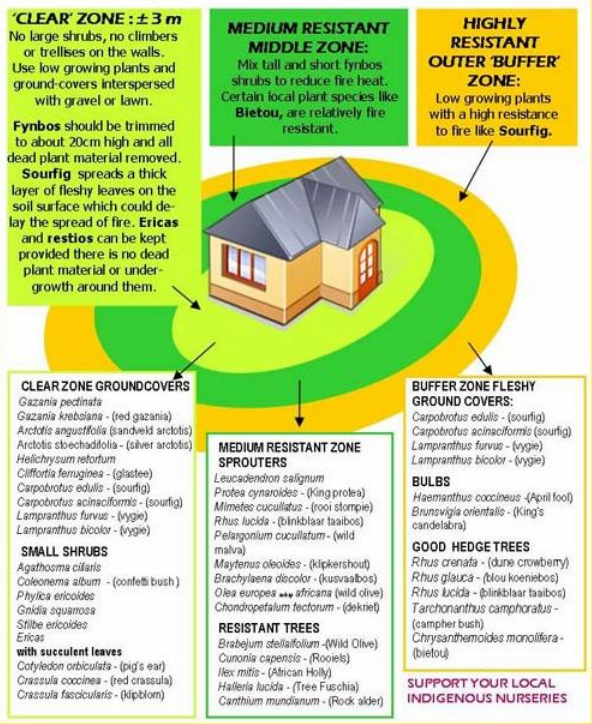
Keep low‑flammability plants (higher moisture content) closer to the house, and avoid tall, dense fuels right at the structure’s edge.
-
Keep a 3m strip around your house walls free of vegetation.
-
Avoid planting densely under eaves, or around any wooden structures.
-
Plant indigenous species which often have fire-retardant properties. Here are some suggestions.
Firewise Maintenance
- Clear roof valleys and gutters of leaves, needles, and debris.
- Ensure outdoor fuel loads (braai wood storage, combustible furniture) are stored away from walls and openings.
- Keep your garden clear of dry, dead vegetation, and dispose of cuttings and brush immediately